


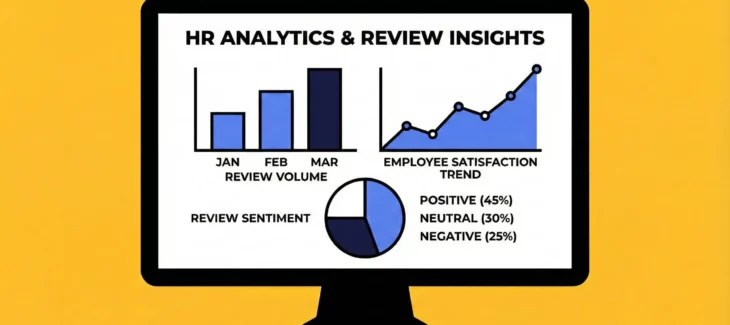
Key takeaways
- Understand the most important human resources formulas used in HR analytics.
- Learn how to calculate key HR metrics like employee turnover rate, cost per hire, and time to fill.
- Discover how HR formulas can enhance employee engagement measurement and retention strategies.
- Gain insights into integrating HR metrics with employer branding and workforce planning.
- Explore how sentiment analysis and automated review moderation support data-driven HR decisions.
Human resources formulas serve as the backbone for precise and actionable HR metrics, essential in optimizing workforce management and strategic decision-making. These formulas help HR Analytics Specialists convert raw HR data into clear insights that drive improvements in recruitment, retention, engagement, and productivity. Platforms like Review.jobs equip professionals with AI-powered insights and authentic employee reviews, enhancing the accuracy and relevance of HR analytics. This article delves into key human resources formulas, provides practical examples, and illustrates their application in improving employer branding and overall HR functions.
Understanding human resources formulas and their importance
Human resources formulas comprise specific calculations used to quantify performance indicators, engagement levels, recruitment efficiency, and retention outcomes, collectively known as HR metrics. Accurate application of these formulas allows HR teams to assess workforce trends, identify challenges, and guide strategic initiatives effectively.
The reliability of workforce management hinges on precise HR metrics, as they translate qualitative human factors into quantifiable data. This facilitates objective evaluation of HR initiatives and allocates resources where they have the greatest impact.
Key HR functions include recruitment, onboarding, employee development, performance management, and retention. These functions rest on foundational HR pillars such as compliance, employee relations, compensation, and workforce planning. The 5 C’s of HR—Competence, Consistency, Commitment, Culture, and Communication—offer a conceptual framework ensuring comprehensive personnel management.
- Competence: Ensuring employees have the necessary skills and knowledge.
- Consistency: Applying HR policies fairly across the workforce.
- Commitment: Fostering employee dedication to organizational goals.
- Culture: Building a work environment that supports growth and inclusion.
- Communication: Facilitating effective information exchange between leaders and employees.
Core HR formulas for measuring workforce performance
Several core formulas measure workforce performance, offering insights into employee movement, productivity, and recruitment efficiency. Employee turnover rate formula is a crucial indicator calculated by dividing the number of separations during a period by the average number of employees, multiplied by 100. This metric highlights retention challenges or success.
Cost per hire tracks recruitment expenditure by dividing total recruitment costs by the number of hires within a given timeframe. This formula aids in budgeting and improving recruitment strategies.
Time to fill calculates the average number of days taken to fill vacant positions. It is computed by measuring the span between job requisition approval and candidate acceptance. This recruitment metric reveals process efficiency and potential bottlenecks.
Core HR formula examples
| Metric | Formula | Purpose |
|---|---|---|
| Employee turnover rate | (Number of separations / Average number of employees) × 100 | Measures workforce stability and retention |
| Cost per hire | Total recruitment costs / Number of hires | Assesses recruitment financial efficiency |
| Time to fill | Sum of days to fill positions / Number of positions filled | Evaluates recruitment process speed |
Measuring employee engagement and satisfaction using HR formulas
Employee engagement metrics are vital to understanding workforce motivation and productivity. Formulas synthesizing survey results, participation rates, and sentiment analysis in HR transform qualitative feedback into measurable scores. For instance, engagement score can be calculated by averaging survey responses weighted by relevance. Consistent employee review templates standardize the inputs behind these scores.
Employee retention rate formula complements turnover data, computed by dividing the number of employees retained at period end by the number at period start, multiplied by 100. High retention rates usually reflect effective engagement and satisfaction.
Sentiment analysis in HR employs natural language processing to quantify employee opinions collected via surveys or reviews. Quantifying tone is step one; acting on negative feedback examples is what changes morale. This approach enhances understanding beyond numerical ratings, identifying emotional undercurrents affecting morale.
Advanced HR formulas for diversity, training, and development
Diversity and inclusion metrics utilize formulas assessing representation ratios, such as the proportion of employees from underrepresented groups relative to the total workforce. These measurements guide organizational efforts towards equitable hiring and promotion practices.
Training ROI formula calculates the financial return on investment in learning and development by dividing net benefits of training (e.g., productivity gains) by training costs, then multiplying by 100. Accurate training ROI figures justify budgets and illustrate program effectiveness.
Workforce productivity is often measured by output per employee, calculated by dividing total output or revenue by the number of employees. Tracking this metric over time highlights the impact of development initiatives and process improvements.
Applying HR formulas for employer branding and online reputation
HR metrics directly influence employer branding strategies by providing credible data that demonstrate organizational strengths and areas for growth. These metrics also make the EVP measurable in practice rather than a branding statement. Integrating employee feedback collected via anonymous review submission fosters genuine insight, enhancing online reputation management.
Secure review collection methods encourage candid responses, while automated review moderation powered by AI streamlines content evaluation to maintain authenticity and relevance.
Centralized review management centralizes employee feedback, simplifying analysis and response coordination. Public employer profiles leveraging aggregated HR metrics showcase transparency and attract talent. Sharing performance results through social media amplifies employer branding efforts and recruitment reach.
Leveraging HR analytics and data-driven decisions with formulas
Data-driven HR decisions depend on accurate metrics derived from robust human resources formulas. Integrating quantitative data and qualitative insights enables HR leaders to tailor workforce strategies to organizational goals.
Examples of actionable insights include adjusting recruitment tactics based on cost per hire trends or developing customized retention initiatives informed by turnover rate analysis. These precise measurements contribute to evidence-based decision-making processes.
AI-powered HR insights complement traditional analytics by automating data processing, sentiment analysis, and pattern detection, thus elevating workplace insights. Harnessing these technologies alongside human expertise produces smarter, more effective HR outcomes.
Frequently asked questions
What are the key HR metrics and how are they calculated?
Key HR metrics include employee turnover rate, cost per hire, time to fill, employee retention rate, and employee engagement scores. These are calculated using specific formulas: turnover rate is (Number of separations / Average number of employees) × 100; cost per hire is Total recruitment costs / Number of hires; time to fill is the average number of days to fill a position; retention rate is (Number of employees retained / Number at start) × 100; employee engagement is often derived from survey result averages weighted by importance.
How do you calculate employee turnover rate?
Employee turnover rate is calculated by dividing the total number of employees who leave during a period by the average number of employees during the same period, then multiplying by 100 to express it as a percentage. The formula is (Number of separations / Average number of employees) × 100.
What is the formula for cost per hire?
The cost per hire formula divides the total expenses associated with recruitment (such as advertising, recruiter salaries, and onboarding costs) by the total number of hires made in a given period. It is calculated as Total recruitment costs / Number of hires.
How can HR formulas improve employee retention?
HR formulas such as employee turnover rate and retention rate identify patterns in workforce stability. Analyzing these metrics reveals retention challenges, allowing HR professionals to devise targeted engagement, development, and recognition initiatives that encourage employees to stay.
What are the 5 C’s of HR?
The 5 C’s of HR are Competence, Consistency, Commitment, Culture, and Communication. They represent key focus areas to ensure effective human resource management and employee relations.
What are the 7 HR functions?
The 7 HR functions include recruitment and staffing, training and development, performance management, compensation and benefits, employee relations, compliance with labor laws, and HR planning and analytics.
What are the 7 pillars of HR?
The 7 pillars of HR typically refer to foundational areas of human resources management: talent acquisition, workforce planning, learning and development, performance management, employee engagement, compensation and benefits, and compliance and risk management.
How is employee engagement measured using HR formulas?
Employee engagement is commonly measured by analyzing results from employee satisfaction surveys through formulas calculating average scores or engagement indices. Sentiment analysis on qualitative feedback enhances understanding by quantifying emotional tone and themes within responses.
What is time to fill and how is it calculated?
Time to fill measures the average duration between job requisition approval and the acceptance of a job offer by a candidate. It is calculated by summing the total days taken to fill each position and dividing by the number of positions filled.
How can sentiment analysis be used in HR?
Sentiment analysis utilizes AI to interpret employee feedback from surveys and reviews, quantifying positive, neutral, or negative emotions. This insight helps identify workplace morale, uncover hidden issues, and guide engagement strategies.
What are the best methods for anonymous review collection?
Best practices for anonymous review collection include secure online platforms that mask user identities, encrypted data transmission, and clear communication ensuring confidentiality. These methods promote honest feedback that directly informs HR improvements.
How do HR analytics support data-driven decision making?
HR analytics translates complex HR data into actionable insights through formulas and statistical models, enabling objective evaluation of workforce trends. This supports informed decision making by providing evidence-based guidance on recruitment, retention, and development strategies.
What formulas are used to measure training effectiveness?
Training effectiveness is measured using training ROI, calculated as (Net benefits of training / Cost of training) × 100. Other metrics include post-training performance improvements and employee participation rates.
How do absenteeism rates impact workforce management?
Absenteeism rate formula, calculated by dividing total absent days by the total available workdays and multiplying by 100, reveals attendance issues. High absenteeism affects productivity, increases costs, and signals possible morale or health problems that HR must address.
How can HR metrics aid employer branding efforts?
HR metrics provide authentic data showcasing organizational strengths in areas like employee satisfaction, retention, and diversity. Integrating these metrics into public employer profiles and social media sharing enhances credibility and attracts top talent.
What are common formulas for recruitment metrics?
Common recruitment formulas include cost per hire, time to fill, applicant conversion rate (number of candidates hired divided by total applicants), and time to hire (from candidate application to offer acceptance). These measure efficiency and effectiveness of recruitment processes.
How to analyze employee satisfaction with HR formulas?
Employee satisfaction is analyzed by averaging survey scores related to job satisfaction, work environment, and management support. Complementary methods include sentiment analysis on open-ended responses and tracking changes over time to identify trends.
Final thoughts
Mastering human resources formulas equips HR Analytics Specialists with the tools to deliver precise, data-driven workforce insights that optimize human capital management and enhance employer branding. Review.jobs stands out as a trusted partner by providing AI-powered HR insights and authentic employee reviews, enabling professionals to translate HR metrics into strategic advantages.